
 Document
Mesh Selection for Hernia Repair: Expert Review of Biologic, Synthetic and Bioabsorbable Types
Today, mesh closure is the standard in hernia repair, a credit to advances in materials and surgical techniques since usher. Document
Clinical Use of GORE® BIO-A® Tissue Reinforcement in Ventral Hernia Repair Using the Components Separation Technique
Many repaired incisional or ventral hernias recur; thus, the primary objective of research and technological developments pertaining to these hernias has long been to minimize recurrences without increasing treatment-related complications. Video
Video
Retromuscular hernia repair using GORE® SYNECOR Preperitoneal Biomaterial with transfascial suture fixation
John P. Fischer, M.D., MPH, FACS, is a specialist in abdominal wall reconstruction. This is a surgical technique video demonstrating the retromuscular repair using GORE® SYNECOR Preperitoneal Biomaterial with transfascial fixation.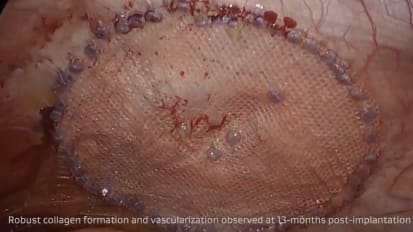 Video
Video
Post-Operative View: 13 Months Post Implantation
GORE® SYNECOR Intraperitoneal Biomaterial Lap ventral hernia repairs Video
Video
Robotic TAR and Incisional Hernia Repair with GORE® SYNECOR Preperitoneal Biomaterial
Rodolfo J. Oviedo, MD, FACS, FASMBS, narrates on a robotic transversus abdominis release (TAR) and incisional hernia repair. News
News
GORE® SYNECOR Biomaterial
The advantages and disadvantages of using synthetic, biologic and biosynthetic material for hernia repair and abdominal wall reconstruction procedures remain a subject of debate. Document
Quality of Life in Ventral and Hiatal Hernia Repair: Review of Long-Term Patient Outcomes in Two Large Case Series
A fundamental goal of hernia repair is providing a durable closure. Document
A Cost Comparison of Mesh Usage in Laparoscopic Paraesophageal Hernia Repair
The aim of this study was to compare costs of the GORE® BIO-A® Device, ALLERGAN ALLODERM Device, and ALLERGAN STRATTICE Device in relation to the outcomes in terms of length of stay and recurrence rate following PEH repair. Video
Video
Patient quality of life with innovative biomaterials: Clinical review with over seven years of follow up
John Scott, MD, FACS, provides a post-operative clinical review of patients' quality of life after a hernia repair.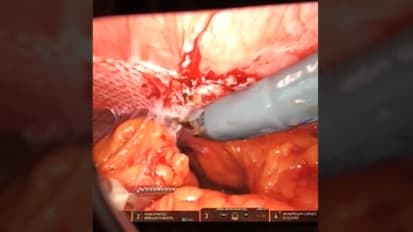 Video
Video
Post-Operative View: 18-Months Post-Implantation GORE® SYNECOR Intraperitoneal Biomaterial
Razvan Opreanu, MD, shares an 18-month post operative view using GORE® SYNECOR Intraperitoneal Biomaterial.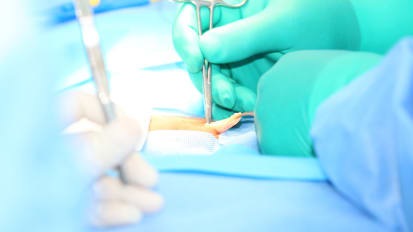 Document
Learn More About GORE® SYNECOR Biomaterials
Hybrid hernia repair device for high BMIs, multiple comorbidities and recurrent defects are now available. Document
The Role of a Biosynthetic Hybrid Mesh in Abdominal Wall Hernia Repair in High-Risk Patients with Multiple Comorbidities
The influx of more high-risk and obese patients in need of abdominal wall hernia repair naturally leads to larger, more complex hernia cases and the need for strong mesh.