
 Document
Biosynthetics — Know your options
"[Biologic] materials come with only moderate durability, and at substantial financial cost. Slowly absorbable biosynthetic implants, as a class of hernia meshes, represent a possible cost-effective solution. In the final analysis." Document
A Cost Comparison of Mesh Usage in Laparoscopic Paraesophageal Hernia Repair
The aim of this study was to compare costs of the GORE® BIO-A® Device, ALLERGAN ALLODERM Device, and ALLERGAN STRATTICE Device in relation to the outcomes in terms of length of stay and recurrence rate following PEH repair. Video
Patient quality of life with innovative biomaterials: Clinical review with over seven years of follow up
John Scott, MD, FACS, provides a post-operative clinical review of patients' quality of life after a hernia repair. Video
Clinical Experience with GORE® SYNECOR Intraperitoneal Biomaterial
Donald Cugini M.D., presents a case using GORE® SYNECOR Intraperitoneal Biomaterial for umbilical hernia repair. Video
Trends, Tools, Trials: Complex Abdominal Wall Repair in 2020
Matthew I. Goldblatt, M.D., FACS, discusses a case study of a patient undergoing treatment for simultaneous colon and rectal cancers and had a prior low anterior colon resection procedure with a diverting ileostomy. Document
General Surgery News Special Report: Quality of Life in Ventral and Hiatal Hernia Repair: Review of Long-Term Patient Outcomes in Two Large Case Series
In this issue of General Surgery News Special Report, Eric Mallico, M.D., FACS, describes the quality of life of patients after ventral and hiatal hernia repairs, and reviews long-term patient outcomes.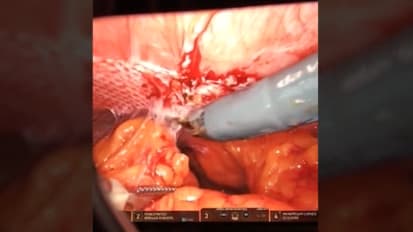 Video
Post-Operative View: 18-Months Post-Implantation GORE® SYNECOR Intraperitoneal Biomaterial
Razvan Opreanu, MD, shares an 18-month post operative view using GORE® SYNECOR Intraperitoneal Biomaterial. Document
A Patient’s Guide to Hernia Repair
While some hernia defects can disappear if they are pressed, this does not permanently resolve the hernia. In addition, because hernias typically worsen over time, the patient should consult a surgeon after a hernia has been identified. Video
Retromuscular hernia repair using GORE® SYNECOR Preperitoneal Biomaterial with transfascial suture fixation
John P. Fischer, M.D., MPH, FACS, is a specialist in abdominal wall reconstruction. This is a surgical technique video demonstrating the retromuscular repair using GORE® SYNECOR Preperitoneal Biomaterial with transfascial fixation.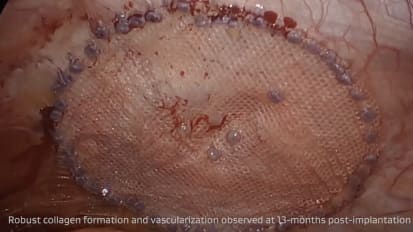 Video
Post-Operative View: 13 Months Post Implantation
GORE® SYNECOR Intraperitoneal Biomaterial Lap ventral hernia repairs Video
Robotic TAR and Incisional Hernia Repair with GORE® SYNECOR Preperitoneal Biomaterial
Rodolfo J. Oviedo, MD, FACS, FASMBS, narrates on a robotic transversus abdominis release (TAR) and incisional hernia repair. News
GORE® SYNECOR Biomaterial
The advantages and disadvantages of using synthetic, biologic and biosynthetic material for hernia repair and abdominal wall reconstruction procedures remain a subject of debate.