
 Document
Biosynthetics — Know your options
"[Biologic] materials come with only moderate durability, and at substantial financial cost. Slowly absorbable biosynthetic implants, as a class of hernia meshes, represent a possible cost-effective solution. In the final analysis." Video
Video
Clinical Experience with GORE® SYNECOR Intraperitoneal Biomaterial
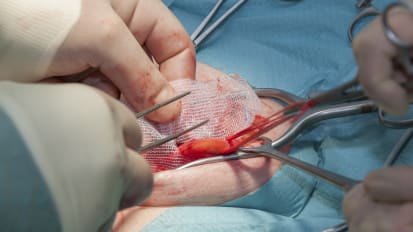
Donald Cugini M.D., presents a case using GORE® SYNECOR Intraperitoneal Biomaterial for umbilical hernia repair. Video
Video
A Hospital Administrator’s Perspective on Economic Value
Eric S. Bour, President, Hillcrest Memorial Hospital and Simpsonville Medical Campus, sits down to discuss how the value of a surgeon and a hospital are being measured today. Video
Video
Robotic Parastomal Hernia Repair with Mesh: Sugarbaker Technique
Rodolfo J. Oviedo, MD, FACS, FASMBS, discusses the Sugarbaker Technique for a Parastomal hernia repair.![Retromuscular hernia repair using GORE<sup>®</sup> SYNECOR Preperitoneal Biomaterial with transfascial suture fixation [Full Version]](http://res.cloudinary.com/broadcastmed/image/fetch/q_auto,c_fill,w_413,h_232,g_faces:center,f_auto/http%3A%2F%2F55933%2Dbcmed%2Es3%2Eamazonaws%2Ecom%2Fbcp%2Fimages%2ForlVideoAssets%2FimgSource%2Fwlg%5F0024%2Epng) Video
Video
Retromuscular hernia repair using GORE® SYNECOR Preperitoneal Biomaterial with transfascial suture fixation [Full Version]
John P. Fischer, M.D., MPH, FACS, is a specialist in abdominal wall reconstruction. This is a surgical technique video demonstrating a retromuscular repair using GORE® SYNECOR Preperitoneal Biomaterial with transfascial fixation.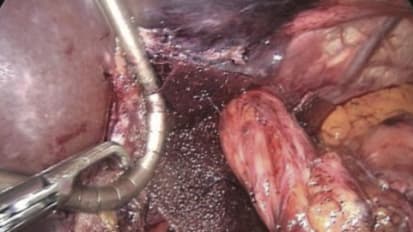 Document
Tissue Reinforcement with GORE® BIO-A® Material in Large Hiatal Hernias: A Prospective Clinical Study
GORE® BIO-A® Tissue Reinforcement is a three dimensional resorbable mesh which has demonstrated to be a ideal “scaffold” facilitating tissue generation and healing without the risk of a non-resorbable implant. Video
Video
Robotic TAR and Incisional Hernia Repair: Step by Step
Rodolfo J. Oviedo, MD, FACS, FASMBS, discusses the robotic transversus abdominis release step by step approach. Video
Video
GORE® BIO-A® Web Technology Innovation
Learn more about the GORE® BIO-A®Understanding Hernia Mesh Materials and Design, as Related to Clinical Needs
Join Howard Levinson, MD, FACS for a clinical discussion on hernia mesh, to understand materials and designs, and how those factors may relate to supporting clinical needs and patient outcomes. Video
Video
Minimally Invasive Surgery Symposium
Professor Michel Gagner discusses how to mitigate risks in bariatric surgery and reminds us that not all reinforcements are the same.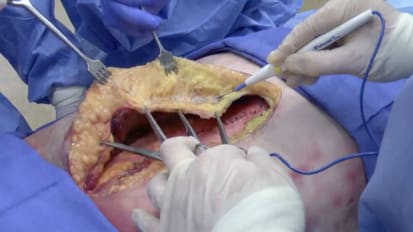 Video
Video
Posterior sheath mobilization in preparation for retromuscular hernia repair
John P. Fischer, M.D., MPH, FACS, is a specialist in abdominal wall reconstruction. This is a surgical technique video demonstrating the posterior sheath mobilization and creation of the retromuscular space.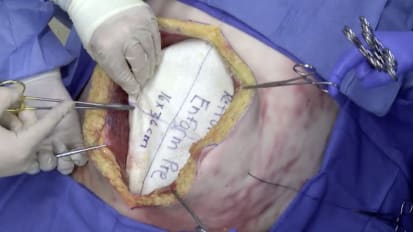 Video
Video
Retromuscular hernia repair using GORE® ENFORM Preperitoneal Biomaterial with percutaneous suture fixation
John P. Fischer, M.D., MPH, FACS, is a specialist in abdominal wall reconstruction. This is a surgical technique video demonstrating retromuscular repair using GORE® ENFORM Preperitoneal Biomaterial with percutaneous fixation.